When every response reads well, writing well stops being what wins the tender.
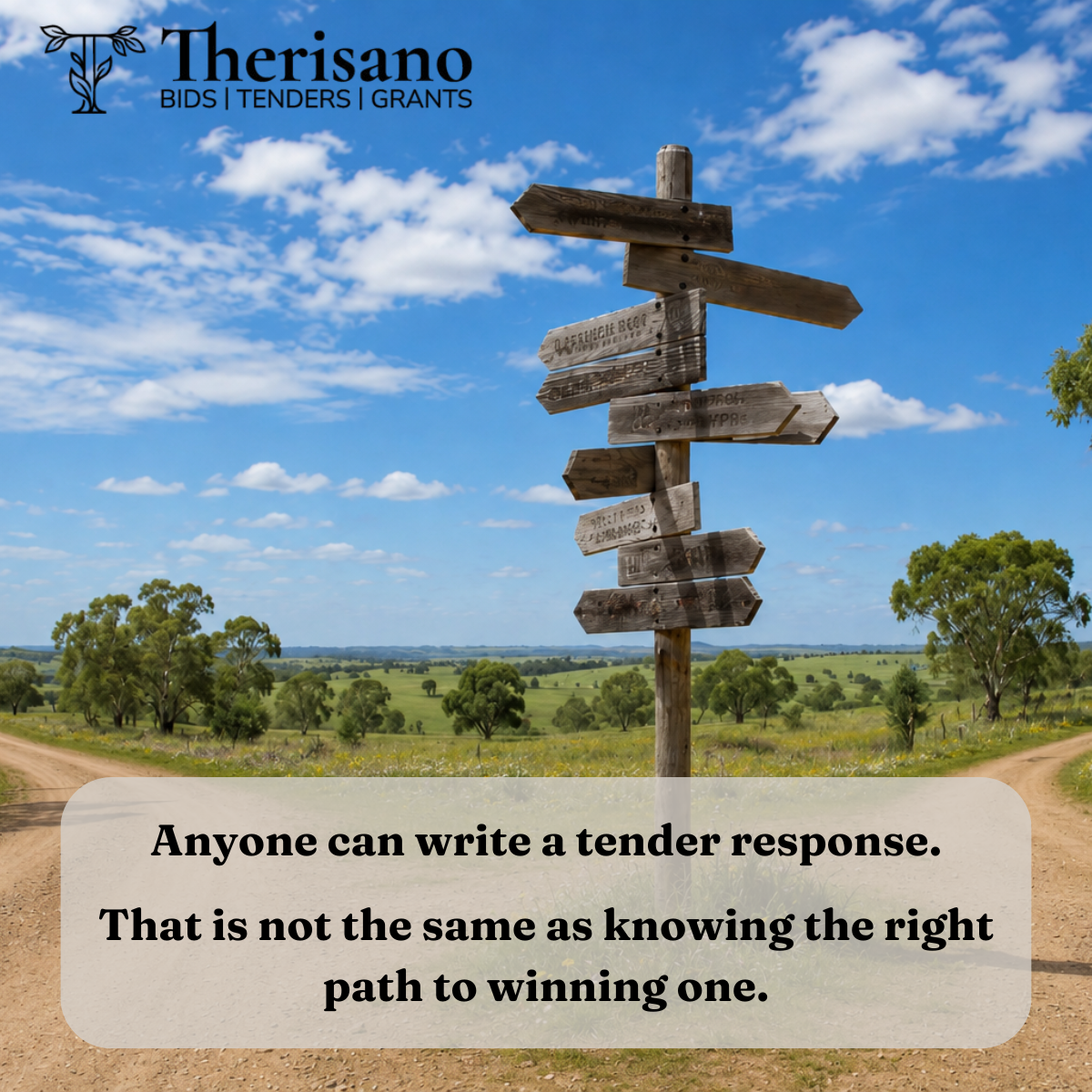
Anyone can write a tender response now. That is not the same as knowing the right path to winning one.
AI has made it possible for almost any business to produce a clean, compliant, readable tender response. That is a good thing.
Work which used to take a week of evenings now takes an afternoon. A small business with no bid team can read an RFT, draft an answer against every criterion, and submit something coherent before the deadline. More businesses competing is good for the market and good for buyers. It has also changed what wins.
What AI changed, and what it did not
Evaluators do not score fluency. They score responsiveness, understanding of the requirement, risk, capability and value for money, against a matrix which was written before your response arrived.
When every response in the pile reads well, writing quality stops separating them. The decision moves back onto strategy.
What we see in the market now is a lot of responses which are compliant, tidy and interchangeable. The same reading of the requirement, taken straight from the RFT. The same methodology. The same claims about quality, safety, local employment and continuous improvement. Nothing for an evaluator to hold onto when they compare five responses which all say yes.
Let's talk about tender response strategy
The first action on Therisano's tender response strategy hit list is understanding the customer's issues and needs.
Where a response demonstrates a well-developed understanding of the customer's pain points, going deeper than what is set out in the RFT documents, and then presents a solution which directly addresses those issues, that response is already ahead of the field.
The RFT tells you what the customer is asking for. It rarely tells you why they are asking for it now. What failed under the last contract. Which stakeholder complaint reached the executive. Which regulatory change lands mid-contract. Which internal capability the buyer no longer has. Those are the things the response has to speak to.
We start with analysis of the tender documents and research.
First, research the customer's broader operating environment
Public reports, annual reports and media releases carry sector-specific challenges in plain sight. Government initiatives and strategies show the direction the buyer is being pushed. Regulatory and compliance news shows what is about to become someone's problem. Common pain points across comparable organisations tell you what is likely true here, even where nobody has written it down.
Second, supplement those insights using AI tools
This is where AI earns its place. Analysis at a volume and speed no human bid team can match, across:
- Sentiment – across the broader industry and the general public. Is there a general feeling for industry-specific pain points?
- Keywords – which specific terms recur across the tender documents and the customer's own media releases?
- Competitors – what are competitors doing in this space to address these issues, and which innovations are being developed?
- Trends – what is moving in the local industry?
Third, develop hypotheses and win themes
From the research, propose plausible pain points and test each one against the tender documents. Some hold. Some collapse. The ones which hold become the basis of the response strategy and the win themes which run through every answer.
Build your strategy on the customer's problem, not on your capability.
Where AI stops and people start
We use AI. We are direct about that, because the alternative is pretending research and analysis happen by magic. What AI does not do is write the response.
A win theme is a judgement call. Which pain point to lead on, which risk to name, what to leave out, how hard to push on a competitor's weakness without breaching probity. Those decisions carry consequences, and they need someone accountable for them.
Evidence has to be true and defensible. Contract values, referees, outcomes, staff numbers, certifications. Every claim in a response has to trace back to something real, because an evaluator can ask, and a contract manager will hold you to it later. Generated text fills gaps with plausible material. We flag gaps instead.
Evaluators recognise generated writing. They are reading multiple responses in a compressed week. Generic structure, hedged claims, benefit statements attached to nothing and a paragraph which restates the previous paragraph all read the same way, and none of them score highly.
Tone carries the argument. Naming a shortfall and the control which manages it builds more confidence than unbroken upside. Writing about a client's capability in a way they cannot comfortably write about themselves takes a person who understands both the client and the reader.
Analysis is accelerated. The thinking, the strategy and the written response are human.
What this means for your next bid
If you are already using AI to get responses out the door, keep going. Use it for the compliance work, the first pass on a schedule you have completed twenty times before.
What it will not do is tell you why this buyer should choose you over the incumbent or other competitors. That is the work we do first, before a word of the response is drafted. Research, hypothesis, win strategy, and then a written response which answers the question the buyer is actually asking.
If you have a tender in front of you and you are not confident your response says anything the other bidders will not, talk to us at Therisano.